
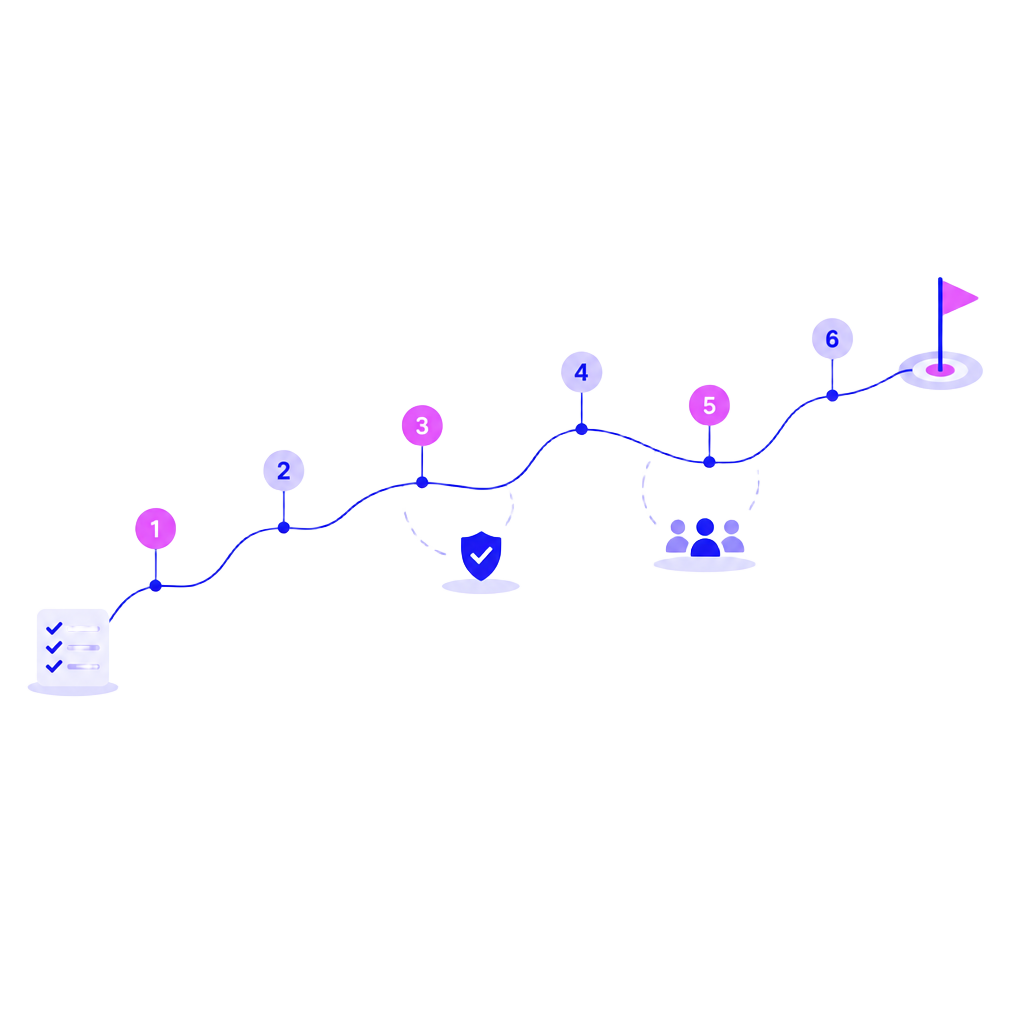
Most Australian organisations already have access to AI. The challenge is turning that access into measurable business value. We've worked with leadership teams that were eager to adopt AI but unsure where to begin, while others had several pilots running without a clear direction. A practical artificial intelligence roadmap provides that direction. It aligns AI strategy with business priorities, reduces implementation risk and helps organisations move from isolated experiments to governed, repeatable systems that improve everyday operations.
Why most Australian organisations need an AI roadmap before buying more AI tools
AI adoption is growing, but business results often lag behind
Artificial intelligence is no longer a future consideration for Australian businesses. Teams are already using generative AI to draft documents, summarise meetings and search internal knowledge. Despite this momentum, many organisations struggle to create lasting business value because their AI adoption has developed organically rather than strategically.
I've seen this in discussions with executive teams. One department proudly demonstrated an AI-powered reporting assistant, another was trialling Microsoft Copilot, while a third prohibited AI altogether because nobody had established governance. Everyone was busy, but nobody was heading in the same direction.
An artificial intelligence roadmap changes what gets measured. Instead of counting how many AI tools are available, organisations start measuring outcomes such as reduced manual work, faster decisions and stronger operational efficiency.
A practical roadmap also answers questions that leadership eventually asks:
- Which AI use cases deserve investment?
- How ready is the organisation for enterprise AI?
- What governance and privacy controls are required?
- How will AI ROI be measured?
- Who owns implementation and ongoing improvement?
Without those answers, AI often remains a collection of disconnected projects rather than a coordinated business capability.
The cost of starting with technology instead of business problems
Buying AI software before understanding the business problem rarely delivers lasting value.
A polished demonstration can make almost any AI platform look impressive. The difficulty begins when that platform must connect with existing systems, comply with the Australian Privacy Act, support staff across multiple departments and fit everyday workflows.
Imagine a professional services firm with offices in Melbourne and Sydney. Leadership purchases an enterprise AI platform after an impressive demonstration. Six months later, consultants still spend hours searching for documents because the platform was never integrated with the firm's knowledge base. Finance questions the investment, staff become frustrated, and confidence in future AI projects begins to fade.
Situations like this are avoidable. A practical AI implementation plan starts by examining where work becomes slow, repetitive or inconsistent before selecting technology.
Consider these questions:
- Which business processes consume the most manual effort?
- Where do reporting delays affect decision-making?
- Which repetitive tasks could benefit from AI automation?
- What data quality issues must be resolved first?
- Which AI initiatives are likely to produce measurable value within the first 90 days?
"A successful AI roadmap starts with business priorities, not software demonstrations."
That gives AI transformation a stronger foundation. Organisations focus on solving real operational problems, building internal capability and putting governance in place that supports long-term adoption.
What an artificial intelligence roadmap includes
An AI roadmap is a business strategy, not a technology checklist
Many people picture an AI roadmap as a timeline of software deployments. In practice, it is much broader than that. A practical artificial intelligence roadmap connects your business objectives, AI strategy, technology roadmap and people into one coordinated plan.
Think of it as the blueprint for how AI will become part of normal work rather than another standalone project.
When we begin conversations with organisations, the discussion rarely starts with models or machine learning. It starts with questions like, "Where are we losing time?", "Which processes create the most frustration?" or "What decisions take too long because our information is scattered?"
Those conversations produce far better outcomes than asking which AI platform has the longest feature list.
A well-designed roadmap helps leadership answer critical questions before investing further:
| Business question | Roadmap outcome |
|---|---|
| Where should we begin? | Prioritised AI use cases |
| Are we ready? | AI readiness and maturity assessment |
| What technology do we need? | AI infrastructure and implementation plan |
| How do we manage risk? | AI governance framework and policy |
| How do we measure success? | Performance metrics and AI ROI |
This approach also strengthens executive sponsorship because investment decisions become tied to measurable business outcomes rather than technical capability alone.
The core outcomes every AI roadmap should deliver
Every organisation's roadmap will look slightly different, but the strongest ones share one trait: they create structure before scale. Rather than launching dozens of AI initiatives at once, successful organisations focus on a handful of priorities they can govern properly.
A practical AI implementation roadmap should deliver:
- A clear AI vision aligned with business strategy.
- Prioritised AI use cases based on value and complexity.
- An AI implementation framework with realistic timelines.
- Defined responsibilities for AI leadership and executive sponsors.
- A practical AI governance framework covering privacy, security and responsible AI.
- A workforce upskilling plan supported by role-based AI training.
- Success measures linked to operational efficiency, productivity and AI ROI.
One operations leader I worked with described their previous approach well: every department had found its own AI tool, yet nobody knew which platform was approved or how information should be handled.
After completing an AI readiness assessment, the organisation reduced more than a dozen disconnected AI experiments into three high-priority initiatives. Each project had an executive sponsor, clear governance, measurable objectives and defined success metrics. The business concentrated on delivering working systems that staff used.
That shift changed the conversation. Instead of asking "What new AI tool should we buy next?", leadership began asking "Which workflow should we improve next?" Technology should support the business strategy, not become the strategy.
As AI capability continues to develop, organisations that succeed will be those with a repeatable operating model. They will know how to assess opportunities, test ideas safely, govern deployments and scale successful solutions across the business. That is what turns AI from a promising experiment into a dependable business capability.
The three foundations that support successful AI transformation
A practical AI roadmap is built on more than technology. In our experience, organisations that see measurable progress treat AI as a business capability supported by three foundations: trust, tools and people. Miss one, and the whole program can wobble.
Trust: governance before scale
One of the biggest misconceptions about AI adoption is that governance can wait until later. It needs to be in place before AI becomes part of everyday work.
Imagine an employee uploads a confidential client proposal into a public AI platform to speed up editing. The intention is good, but without an AI policy or governance framework, the organisation may have created unnecessary privacy and compliance risks.
Australian businesses also need to consider obligations under the Privacy Act 1988, the Australian Privacy Principles (APPs) and evolving guidance around responsible AI. While Australia has not introduced an AI-specific law similar to Europe's AI Act, organisations are still expected to manage privacy, cybersecurity and accountability appropriately.
A practical AI governance framework should cover:
| Governance area | Why it matters |
|---|---|
| AI policy | Defines approved tools and acceptable use |
| Responsible AI | Promotes fairness, transparency and accountability |
| AI risk management | Identifies operational and legal risks before deployment |
| Privacy compliance | Protects sensitive customer and employee information |
| Human oversight | Keeps people involved in high-impact decisions |
Strong governance rarely slows innovation. More often, it gives leadership the confidence to invest further.
Tools: choosing technology that fits existing operations
Technology selection comes much later than many organisations expect.
By the time an organisation begins evaluating vendors, it should already understand its business priorities, workflow bottlenecks and AI objectives. That makes vendor selection far more straightforward.
Instead of asking, "Which AI platform has the most features?", ask:
- Will it integrate with our existing systems?
- Does it support our data strategy?
- Can it scale with the organisation?
- Does it meet our security requirements?
- Will staff use it?
For some businesses, Microsoft Copilot inside Microsoft 365 may solve several productivity challenges. Others may require custom AI assistants, cloud AI services or machine learning models connected to operational systems.
There is no universal answer. The best technology fits the organisation's operating model, rather than forcing the organisation to change everything around it.
People: the capability that determines long-term success
Technology rarely determines whether AI succeeds. People do. Across successful AI implementation projects, organisations invest as much effort in workforce upskilling as they do in software.
A manufacturing business, for example, may introduce AI-powered maintenance forecasting. If engineers understand how recommendations are produced and when human judgement should override them, adoption usually grows quickly. If training consists of a single webinar followed by silence, enthusiasm fades just as quickly.
A practical AI adoption strategy should include:
- Executive sponsorship from senior leadership.
- Role-specific AI training.
- Clear communication about approved AI use.
- Ongoing support during rollout.
- Regular reviews of adoption and business outcomes.
Many organisations also benefit from appointing an executive sponsor or Chief AI Officer to coordinate AI initiatives across departments. Without clear ownership, competing priorities can easily derail implementation.
Ultimately, AI transformation is less about introducing new software and more about helping people work differently. Once staff see AI removing repetitive admin, improving reporting or supporting better decisions, adoption becomes much more natural, and AI starts to feel like part of everyday operations rather than another technology project.
The six practical phases of an AI implementation roadmap
Moving from AI strategy to day-to-day operations rarely happens overnight. Most organisations that successfully embed AI across multiple departments follow a staged approach. Depending on the size of the organisation and the complexity of existing systems, a complete AI implementation roadmap can take anywhere from 18 to 24 months, although meaningful results often appear much sooner.
The important thing is to prove value early, then build on that success.
| Phase | Primary focus | Expected outcome |
|---|---|---|
| 1 | Strategic alignment | Clear priorities and executive support |
| 2 | Infrastructure planning | Secure, scalable technology environment |
| 3 | Data preparation | Reliable data for AI models |
| 4 | Solution development | Tested AI solutions ready for production |
| 5 | Deployment | AI integrated into everyday workflows |
| 6 | Governance and optimisation | Continuous improvement and measurable ROI |
Phase 1: assess AI readiness and build executive alignment
Every successful AI transformation starts with understanding the current state.
An AI readiness assessment identifies where the organisation stands today, which business problems deserve attention first and what capabilities already exist. This is also the stage where executive sponsorship becomes essential. Without senior leadership backing the program, competing priorities can quickly slow momentum.
A practical workshop often focuses on:
- Current business challenges.
- Existing AI capability.
- High-value AI use cases.
- Available data.
- Resource requirements.
- Expected business outcomes.
By the end of this phase, leadership should have a shared AI vision and a prioritised implementation plan rather than a long wish list.
Phase 2: plan infrastructure, security and data requirements
Once priorities are clear, the organisation can design the technical foundations needed to support them.
This includes decisions around cloud AI services, existing infrastructure, cybersecurity controls, system integration and vendor selection. It is also the right time to review data governance, storage requirements and privacy obligations.
Skipping this stage often creates expensive rework later. It is far easier to design for scale now than rebuild systems after deployment.
Phase 3: prepare your data before building AI solutions
If customer records are incomplete, documents are inconsistent or reporting definitions vary between departments, even the most sophisticated AI model will struggle to deliver reliable outputs.
Typical activities include:
- Auditing available datasets.
- Improving data quality.
- Standardising business definitions.
- Establishing data governance.
- Confirming Privacy Act compliance.
Strong data preparation often delivers business improvements even before the first AI solution is deployed.
Phase 4: build, test and validate practical AI solutions
Only after the groundwork has been completed should development begin.
This phase may involve a proof of concept, a pilot program or a production-ready AI solution, depending on the organisation's goals. Some businesses purchase existing platforms, while others develop custom AI applications or intelligent automation tailored to their workflows.
The objective is to show that AI improves a real business process, not just that it works.
Small wins matter here. They build confidence, encourage adoption and create internal advocates for future AI initiatives.
Phase 5: deploy AI into everyday business workflows
Deployment is where many AI projects either succeed or stall.
Launching software is only part of the process. Teams also need training, support and enough time to adjust the way they work.
One practical rollout schedule might look like this:
| Timeline | Milestone |
|---|---|
| Weeks 1 to 2 | Limited pilot with one business team |
| Weeks 3 to 6 | Staff training and workflow refinement |
| Weeks 7 to 10 | Broader rollout across departments |
| Ongoing | Adoption monitoring and performance reviews |
A phased rollout reduces disruption while allowing lessons from early users to improve later deployments.
Phase 6: govern, improve and scale AI across the organisation
A roadmap should never end on launch day.
The strongest organisations continually review AI performance metrics, monitor adoption, assess AI ROI and identify new opportunities for automation or better decision support.
They also revisit governance regularly as new AI capabilities emerge and regulatory expectations continue to develop.
Rather than chasing every new technology release, they focus on one simple question:
"Is this helping our people make better decisions, work more efficiently and deliver better outcomes?"
If the answer is yes, the roadmap is doing exactly what it was designed to do.
Australian AI governance requirements every organisation should understand
How Australia's AI approach differs from Europe and other markets
Australian organisations operate in a different regulatory environment from many overseas markets. Rather than introducing a single AI-specific law, Australia's approach has largely centred on applying existing legislation, strengthening guidance and encouraging responsible AI practices.
For business leaders, that means AI governance should never be treated as a compliance exercise completed at the end of a project. It should be built into the roadmap from the beginning.
Several areas deserve particular attention:
- Compliance with the Privacy Act 1988 and the Australian Privacy Principles (APPs).
- Clear policies covering approved AI tools and acceptable use.
- Data governance and information security.
- Human oversight for decisions that significantly affect customers or employees.
- Ongoing AI risk assessments as systems evolve.
As Australia's National AI Plan continues to shape government investment and the AI Safety Institute expands guidance on AI risks, organisations with structured governance will be in a much stronger position than those relying on informal policies.
Building responsible AI into daily operations
Responsible AI is about building confidence across the organisation as much as reducing legal risk.
When employees understand which AI tools are approved, how information should be handled and when human judgement must remain part of the process, adoption becomes far more consistent.
A practical governance checklist includes:
- Documented AI policy.
- Defined approval process for new AI initiatives.
- Regular AI risk assessments.
- Role-based access controls.
- Ongoing staff education.
- Performance monitoring and periodic reviews.
Good governance creates the confidence to scale. Without it, even successful AI pilots can struggle to gain executive approval for broader deployment.
Choosing AI use cases that deliver early business value
Start with high-impact, low-complexity opportunities
One of the quickest ways to lose momentum is attempting to automate everything at once.
A better approach is to identify a handful of workflows where AI can save time, improve consistency or support better decisions without requiring a major systems overhaul.
Strong starting points often include:
- Internal knowledge search and document retrieval.
- Proposal and report generation.
- Customer enquiry management.
- Meeting summaries and action tracking.
- Forecasting and management reporting.
- Repetitive document processing.
These projects are usually easier to implement, produce measurable outcomes and help build internal confidence before expanding into more advanced AI initiatives.
Industry examples across Australian organisations
The best AI roadmap reflects the realities of the industry rather than applying the same solution everywhere.
| Industry | Practical AI opportunity |
|---|---|
| Mining | Predictive maintenance and safety monitoring across remote operations. |
| Financial services | Fraud detection, regulatory reporting and compliance support. |
| Agriculture | Crop monitoring, yield forecasting and logistics optimisation. |
| Healthcare | Medical imaging support and administrative automation alongside existing clinical systems. |
Although the technology differs, the principle remains the same. Start with practical business problems, prove value early and expand only after governance, people, and processes are ready.
In our experience, organisations rarely struggle because AI lacks capability. They struggle because implementation lacks structure. A practical roadmap provides that structure and gives leadership a repeatable way to identify opportunities, manage risk and deliver measurable business outcomes over time.
Common AI roadmap mistakes that slow enterprise AI adoption
Buying software before completing an AI readiness assessment
A common mistake is committing to an AI platform before understanding where AI will create measurable value.
It is easy to be impressed by demonstrations. It is much harder to integrate those tools into existing workflows, governance processes and business systems.
A readiness assessment helps prioritise the right opportunities before investment begins.
Ignoring data quality and governance
Even the best AI solution depends on reliable data. If customer information is incomplete, reporting definitions vary between departments or governance is unclear, AI outputs become difficult to trust.
That is why data strategy, governance and security should be treated as business priorities rather than technical tasks.
Running too many AI pilots without a long-term strategy
Pilot programs are valuable, but they should lead somewhere.
Successful organisations use pilot projects to validate assumptions, measure outcomes and build internal confidence before scaling. They avoid launching multiple disconnected experiments that compete for attention and resources.
Treating AI as an IT project instead of a business transformation program
AI should improve the way the organisation operates, not simply introduce another technology platform.
The strongest AI initiatives involve operations, finance, service delivery and executive leadership from the beginning. Technology enables change, but people and processes determine whether that change lasts.
Final thoughts: structure before scale
A practical AI roadmap is less about predicting the future and more about making better decisions today.
The organisations making steady progress are not necessarily investing the most money or deploying the newest models. They are taking a disciplined approach: assessing readiness, identifying high-value use cases, building governance early and expanding only after they have demonstrated measurable value.
That approach creates confidence across leadership, encourages adoption throughout the workforce and gives AI a genuine place inside everyday business operations.
Before investing in another AI platform, ask a simpler question:
Does this solve a business problem we have already agreed is worth solving?
If the answer is yes, your roadmap is pointing in the right direction. If not, it may be time to revisit the plan before making the next investment.
TL;DR
A practical AI roadmap helps Australian organisations move beyond isolated AI experiments by aligning technology with business goals, governance and operational priorities. Instead of buying tools first, successful organisations assess AI readiness, prioritise valuable use cases, prepare data, build strong governance and invest in workforce capability. Following a structured implementation roadmap reduces risk, improves adoption and creates measurable business outcomes that can be scaled confidently across the organisation.
FAQs
How often should an AI roadmap be reviewed?
An AI roadmap should be reviewed at least every six to twelve months, or whenever there are significant changes to business priorities, technology or regulations. Regular reviews keep AI initiatives aligned with organisational goals and delivering measurable value.
What is the difference between AI readiness and AI maturity?
AI readiness measures how prepared an organisation is to begin implementing AI today, while AI maturity reflects how advanced its AI capabilities, governance and adoption have become over time. Readiness is the starting point; maturity is the long-term outcome.
Who should own an AI roadmap within an organisation?
Executive leadership should sponsor the roadmap, but ownership is often shared between operations, technology, data and business leaders. Larger organisations may appoint a Chief AI Officer or establish an AI Centre of Excellence to coordinate governance, implementation and continuous improvement.
Can small and mid-sized Australian businesses benefit from an AI roadmap?
Yes. An AI roadmap is valuable regardless of organisation size because it helps prioritise investment, avoid unnecessary software purchases and focus on practical AI use cases that improve productivity and decision-making without overwhelming internal teams.
What are the first signs that an AI roadmap is delivering results?
Early indicators include reduced manual work, faster turnaround times, stronger employee adoption, more consistent reporting, improved decision-making and measurable productivity gains. As confidence grows, organisations can expand AI into additional workflows while maintaining governance and control.